isaac-net

isaac-net simulates the 5G (and Wi-Fi) uplink of thousands of robot-learning environments at once on one GPU, stepped in lockstep with the physics of Isaac Lab or MuJoCo Playground. A policy therefore trains against queues that build up when the team transmits together, links that degrade as robots move, and retransmissions that stretch the delay tail, instead of a fixed or random delay.
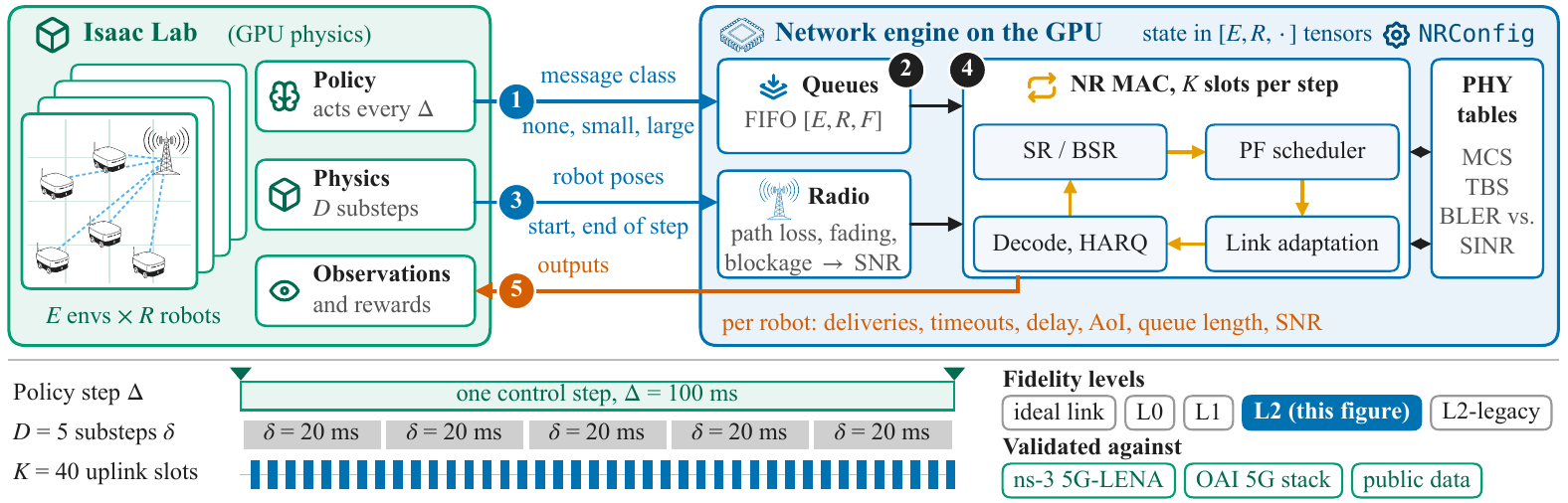
One control step: the simulator submits message classes and robot poses, the engine runs the uplink slots of the NR MAC with all state in [envs, robots, ...] tensors, and per-robot deliveries, delays, age of information and SINR return as observations.
Quick start
pip install isaac-net # install the PyTorch build you want first (2.7+); on Linux its CUDA build includes Triton
import torch
from isaac_net import NRConfig, Requests, make_engine

E, R = 64, 8                                                   # 64 environments x 8 robots
net = make_engine("L2", E, R, "cpu", NRConfig(), seed=0)       # on a GPU: "cuda", backend="triton"
pos = torch.rand(E, R, 2) * 100.0                              # robot positions in metres
for t in range(20):
    net.submit(None, Requests((torch.rand(E, R) < 0.3).long()))   # 1 = one 4 kB message, 0 = nothing
    out = net.step(None, pos)                                  # one control step = 100 ms for every env
print(f"mean delay {out['delay'][out['delivered']].mean() * 100:.1f} ms, queued {int(out['queue_len'].sum())}")
No install at hand? Open the quick start in Colab: it runs on a free CPU or GPU runtime in under three minutes.
Next steps
- Choose a configuration: which fidelity level, backend, preset and simulator fit your experiment, with costs and what each one leaves out.
- Work through the tutorials: from a first network to fidelity levels,
NRConfig, the Isaac Lab layer and validation against ns-3. The Cookbook and the FAQ answer the questions that come next. - Put the network into Isaac Lab: four hook calls in a
DirectRLEnv, on Windows or kit-less on Linux.
Concepts explains the ideas behind the engine (slot-synchronous stepping, fixed shapes, per-env clocks, backends), and Status lists what is done and what is open. The package is a research prototype: version 0.2.0 is on PyPI, and the code is on GitHub.
Citation
If you use isaac-net, please cite the paper, arXiv:2610.02370. Zifan Zhang and Mingzhe Han contributed equally.
@article{zhang2026isaacnet,
  title   = {Network-in-the-Loop at Scale: GPU-Batched 5G Simulation for Massively Parallel Robot Learning},
  author  = {Zhang, Zifan and Han, Mingzhe and Athreya, Kannan and Liu, Yuchen},
  journal = {arXiv preprint arXiv:2610.02370},
  year    = {2026},
  note    = {Zifan Zhang and Mingzhe Han contributed equally}
}
Building these docs
pip install -e ".[docs]"
mkdocs serve                     # live preview at http://127.0.0.1:8000
mkdocs build --strict            # what CI runs
The API reference is generated from the docstrings. Tutorials 01–05 are stored executed and rendered without running them, and bash tutorials/build_notebooks.sh regenerates them from the scripts in tutorials/. The Colab quick start is a notebook of its own, stored executed as well.